Search this blog

Posts tonen met het label social. Alle posts tonen

juli 17, 2014

Yo for lunch


Today my colleague told me about Yo.
Yo? Yes Yo. Just Yo.
 Instantly we started installing the app, and all created a username. I guess you could say we are early adopters in the technology adoption lifecycle.

 Yo is the newest free social app, available for IOS and Android. 

And Yo takes simple to the extreme. Using ZERO characters to communicate. Just click a contact to say 'Yo'.

 
I remember the poke from Facebook. Which I never really got. What did it mean? But with Yo it all seems to fit. Yo is a word that can be used in many contexts. You just instantly know when a friend says 'yo' what that means.

Many will say that Yo is just a joke. But within just a few weeks time it reached the top of the download charts.

How does it work?

Sign up, create a username, and invite friends. Then tap their name to say Yo. 


Yo me for user adoption consultancy request
Here's what Yo says about Yo:
Yo is everything and anything, it all depends on you, the recipient and the time of the Yo.
Wanna say "good morning"? just Yo.
Wanna say "Baby I'm thinking about you"? - Yo.
"I've finished my meeting, come by my office" - Yo.
"Are you up?" - Yo.
The possibilities are endless.

Yo is the manifestation of the human need to communicate more efficient. Just like a car 'honk' to tell you to get outside and get in the car, or using a broom to bang on the ceiling to tell the upstairs neighbour to be quiet.

Doing the same with less resources (less effort, time, location, etc) is one of the passions of the human race.  Says Ofer Spiegel.


Creator and owner of Yo, Or Arbel, describes it this way:


Yo to sign up for tomorrow's lunch at Silverside


Yo is so great because of it's contextual power. Any Yo could mean anything. It's up to the group of friends to get a specific meaning. Between a group of people there is a context and they understand what Yo means.

At the Silverside office we found our first use case for Yo. Easily.

We just moved to a new office building. We are the very first tennants, and with only the Silverside crew there, lunch facilities are not fully matured yet. But we have a fantastic receptionist who prepares an awesome lunch table for us.

All we need to do is tell her we are in tomorrow, and would like to have lunch . We could send an email, ofcourse. But somehow that seems to be too much trouble. So we end up arriving at the office in the morning wondering if we could still get some lunch.

But now we have Yo. Within 5 minutes we arranged 'our Yo agreement'. Whenever she gets a Yo from any one of us, that colleague is signing up for lunch the next day.

It's that simple.

Yo is the notification, you and your team decide the context.

Interested? Yo me. I consider your Yo as 'Yes I'm interested to have a conversation to discuss user adoption strategies'.


juni 27, 2013

Book on Doing Business with IBM Connections

Recently I received Michael Sampson's new book 'Doing business with IBM Connections 4.5'. Being a huge fan of his previous work I had been awaiting with much anticipation the arrival of it ever since it was announced even before Connect 2013 in february this year.

If you are going to embark on a social busines journey using IBM Connections this is a MUST read! In fact, if you are embarking on a social business journey with any kind of social software this book will give you guidance on a practical approach for improving business processes through collaboration scenarios.

The book is set up with 10 chapters on collaboration scenarios. Each scenario comes with 2 Case Studies from organizations having implemented IBM Connections, showing their experience in that particular scenario. From the 20 case studies no less than 5 are from the Netherlands! These are from Silverside, Saxion (both on managing meetings), Forbo Eurocol (Sharing Team updates), LeasePlan (Finding Expertise), Sasja Beerendonk e-office (Individual Coherence).  Yes indeed, that last case study would be me :-)
5 out of 20 case studies, now that is quite impressive for such a tiny country!


januari 27, 2013

Change is social

Those attending IBM Connect may be very familiar with socializing and networking, but your employees might not be adopting this new way of collaborating so easily. In my session 'Become a Social Business: Leverage User Adoption Through Gamification' I explain why and how gamification an be used to make employees understand how Connections can be used to collaborate in a new way.

Here's a little something out of my session 'BP304 Become a Social Business: Leverage User Adoption Through Gamification' for you to get you going.


Gamification helps to spread the 'virus' of user adoption

One of the characteristics of social networks is it easily spreads information. Just like a virus the information can easily flow through the networked components. In IBM Connections the employees are the 'nodes' that are connected. Connections should help organisations to have better access to information, find out what's going on in the separate silos made by organizational structures such as departments and enhance collaboration between people. In order to achieve this, employees need to start building social networks.

Some people are better connected than others. They are the 'hubs' in the connected organisation. These hubs play an important role to change behaviour of the other employees. They can help other employees adopt IBM Connections.

Gamification uses networks of people to enhance adoption. Through gamification the early adopters and influencers start earning point and badges. The colleagues in their network can see their progress through the Activity Stream.


Building networks in Connections with gamification

The theory explained in The strenghth of weak ties states that networks become more powerful the further they are removed from you. Gamification can be used to start building profiles and networks and the network itself can encourage other users to indulge in gamification and improve their profile and network.

Source: Granovetter: the strenght of weak ties

Let's see how this works:

First people are encouraged to build their Profile, the pre-requisite to becoming a networked organisation. Secondly employees are encouraged to build networks, starting with the people close to them at first probably, such as their manager and their direct team members. But this network will slowly grow to other circles as they will work with others on projects or get introduced to previously unknown colleagues through their current close circle of colleagues.

When somewhat connected to colleagues they will be influenced by their peers, especially the ones that are well-connected and perform as innovators. Innovators have a tendency to be 'hubs' in the network of the organisation. They are the ones everybody turns to, to ask for advise and they are the ones who acquire the most links. A phenomenon known as 'the rich get richer' in social nework analysis.

The innovators will most likely start earning badges quite early, as they will adopt the new way of working and actually are writing blogs, participating in or even leading communities, do regular status updates and share and collaborate on files.

Through the network and the Activity Stream in Connections their 'followers' will see them earning points and badges. Seeing them getting badges for this and that can trigger the follower to participate in the same behaviour, trying to accomplish the same thing and as a result seeing the real value of the activity itself. By watching the activities of these innovators in their network, they will soon adopt the same behaviour.


Get more

Come join my session BP304 Become a Social Business: Leverage User Adoption Through Gamification on tuesday 4:15-5:15 in SW Pelican1-2 at IBM Connect to learn more about gamification for IBM Connections.


januari 15, 2013

The thrill of going to IBM Connect 2013

This year will be my first time actually attending IBM Connect. That in itself is exciting enough, but I am not just attending some great sessions, but I am a speaker as well. I've been doing sessions at several other events before, but this is something different completely!

The last month has been a very busy month, with mailing and socializing on all kinds of platforms with several people from IBM. From mails about the technical preparations to stern yet funny emails from my track manager Susan Bulloch, I've been in awe with the tight scheduling and organizing and information flow coming to me. There have been so many people assisting and answering questions so swiftly, it's amazing.

Ofcourse the thrill for me started when my session BP304 Become a Social Business: Leverage User Adoption Through Gamification was approved early december. That's when things really became hectic with creating the presentation, and filling in all sorts of forms and ofcourse scheduling flights and hotels.

I've been eager to see what other sessions would be listed. Now they are all known and I'm even more excited! You can check them out yourself, for example by downloading The totally unofficial and totally unsupported IBM Connect session database Mat Newman provided for us, which now is available in a mobile version too! There are some really great speakers and sessions on all kinds of topics. The topic I am speaking about (gamification) has some more interesting sessions:
  • Growing a Smarter Workforce through Social Gaming
  • Using Gamification to Ignite the Widespread Adoption of IBM Connections
  • Social CMO: Engaging the Consumer
  • The wednesday Keynote by Jane McGonigal
So if you are interested in the topic of gamification and adoption, go see any of these, or mine.

Today I joined a webinar about Vivastream. This is the tool used for IBM Connect 2013 which allows speakers and attendees to interact in a great way. I hope to speak to you there soon.  I will also get you involved before they start, on two BOF sessions I am doing:

  • BOF106 Using Actvities to Manage Meetings (together with Marion Vrielink, Saxion University)
    Tuesday 6.30-7.30 pm in Macaw 2
  • BOF108 Metrics That Matter. Insight to Employee Engagement
    Wednesday 7.00-8.00 am in Macaw 1
The Vivastream for Connect will allow us to do polls and contact each other  So you can expect to get some polls for the above mentioned BOF sessions! I invite you to join me in the interaction!


december 01, 2012

Social Connections IV community twitter graph

Another great Social Connections event full with brilliant speakers from all over the world has taken place this November 30th in Amsterdam. Social Connections IV had more attendees than ever (200) and was packed with three tracks of presentations by IBM'ers, business partners and customers solely about social business with IBM Connections.

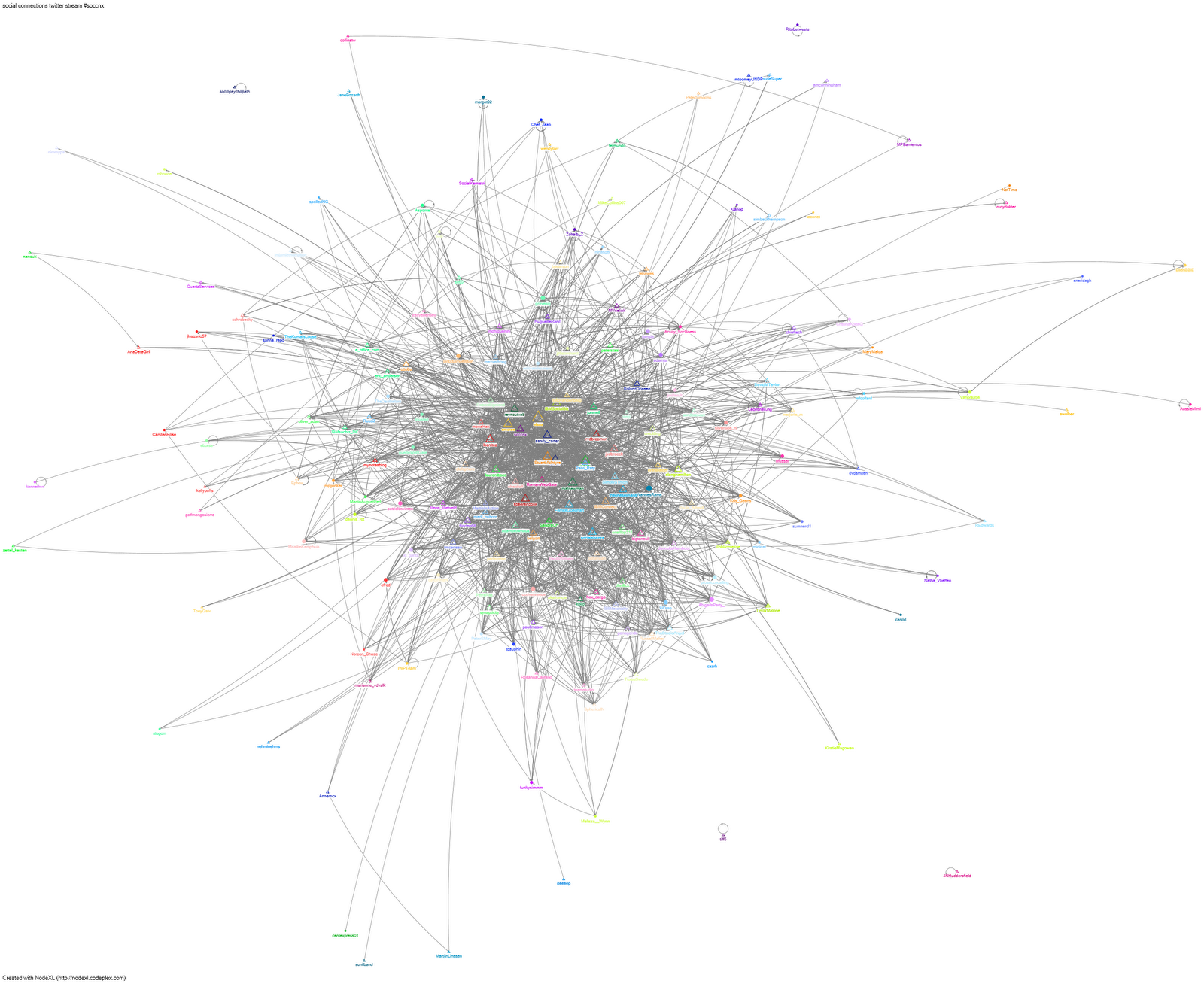
As usual there is quite a bit of tweeting going on during an event, and Social Connections is no exception. The hashtag for the event is #soccnx. Doing some network analysis delivers a great graph of the Social Connections IV community. The graph displays all the connections between attendees (and even non-attendees) that have tweeted #soccnx.


Graph of #soccnx twitter network during Social Connections IV
Download a larger version of the graph to see more detail.

Social Connections community is tightly connected
The graph is compiled of 210 vertices (nodes) and 4010 edges (links). These are the twitter accounts and their connections to eachother. The average geodesic distance is 2,113666 and the maximum still only 4 - meaning that the Social Connections community is a tightly connected community. On average every person is only two links away and the maximum is 4 degrees of separation. So even less than the famous (unproven) theory 6 degrees of separation. Just exactly how close everybody involved is to one another is also apparent from the number of connected components: there are only 5 'subgraphs' of tweeters that are connected to each other but not to anyone in one of the other subgraphs.

When digging deeper into the table underlying the graph I can give some insight in various types of measures of the centrality of a vertex within a graph that determine the relative importance of a vertex within the graph 
(devided into degree, closeness centrality, betweenness centrality, eigenvector centrality and PageRank).

Top 20 vertices (tweeters) by Eigenvector Centrality


The top names are not surprising. They are the ones organising the event, speakers, IBM employees or very influential people in the IBM social business arena.

september 12, 2012

Testdrive IBM Connections 4 on October 4

sustainable highway to improve internal collaboration and knowledge


e-office would like to invite you to get acquainted with IBM Connections 4 - the latest version of the collaboration platform from IBM -on October 4.

IBM Connections is social software for the leading collaboration and knowledge sharing easy. The new version makes it possible to no longer work from your inbox. In Connections 4 are all sources of information and actions together. Connections 4 offers can also be integration with SharePoint, making it an integrated workplace for employees arises.


Are you ready for this way of working? Come experience Connections 4 and see for yourself. On October 4, you can use the software hands-on. Even if you do not know IBM Connections this is a great event to start discover the capabilities of the software.

As e-office, we are convinced that our future as effective, sustainable and profitable organizations lies in solutions that are possible with IBM Connections. On October 4, besides a test drive of Connections 4, we offer you an additional testdrive: in an electric car. All participants can drive several electric cars during lunch time. 

when:
Donderdag 4 oktober, 9.30 – 14.00 uur

where:
Elektrisch Vervoer Centrum Rotterdam, Delftseplein 24, Rotterdam

program:
9.30 uur    Reception in Rotterdam
9.45 uur    vision on social business  
                Roland Hameeteman, ceo e-office 
10.00 uur  introducing IBM Connections 
                Luis Benitez, social software product manager IBM
11.00 uur  break
11.15 uur  testdrive Connections 4  
                Sasja Beerendonk, social business strategist & trainer, e-office
12.45 uur  lunch & testdrive e-cars 
14.00 uur  roundup (and return e-cars) 

sign up

You can register via the registration form.

Do you have a preference for a particular electric car? Look here for the list of available vehicles and give your preference to us via the registration form!

Note: for the test drive yYou need a valid drivers license.

september 09, 2012

Change habits with Connections Mail integration

With IBM Connections 4 being released a few days ago the discussion about Mail starts again. As you may know, IBM Connections integrates Mail and Calendar into the browser window. Is integrating Mail into social software a contradiction? Should users not just start using the social software tools instead if e-mail?

Lately I have been talking a lot with customers, thought leaders, colleagues and business partners about IBM Connections Mail (and Calendar). Mail has become something ambiguous these days. There are those, mostly innovators and forerunners, that believe using e-mail is not done, almost something to be ashamed about. They fully embrace social and the new way of communicating and interacting that comes with it. As do I, being an adoption specialist, ofcourse.

I love social and the new way of working (I call this work21) that comes with it. I am a strong believer in IBM Connections for companies to become more agile. I will advocate working openly at any time. In fact I use e-mail less and less in favour of statusupdates, blogs etcetera.

And there are those who are using e-mail all the time as it has been their primary tool for getting work done for about twenty years. And they wholeheartedly believe e-mail is going to stay forever as it is now, and social is not for them, or just a passing phase.

It seems many of the advocates of social are horrified with the idea though that IBM Connections 4 integrates Mail (I never hear them say anything about the Calendar actually). Their point usually being email is a bad way of communicating and should be replaced by Connections social functionality.

But this is, to me, such a harsh stand to make. This will work out fine for 1st wave adopters, but in my opinion is only going to put second wave adopters off. As an adoption specialist I am very much aware of how social software is impacting the way of work. Basically, employees and organisations as a whole need to change their way of working. By now I think it is generally accepted to say that they will not just come if you build it. Adoption is very much necessary, however easy to use a software tool may or may not be.

Adoption is about changing behaviour. The innovators that have long moved to working open and social are amongst the 1st wave adopters. Quite often using new software such as IBM Connections is part of their work. And there's the point I am trying to make: the employees that are now using email as their primary tool for communication and collaboration don't just 'get it'. They need to be taken in to a new way of working, until it becomes natural to them. Unlike 1st wave adopters their work is NOT using new social software. In fact, they might not even enjoy using software at all! Any software to them is just a means to an end. Until the new way of working becomes natural to employees, they will fall back on the tools they know: Email.

Habits die hard. Once you are familiar with a way of working, you're not likely to change that over night. And this is exactly why I think integrating Mail into IBM Connections is so great. It makes it easier for employees to ease their way in to Connections. It takes the familiar way of working into the new environment. It allows for people to work in a browser with their e-mail and calendar, within the context of social. It takes away having to switch between two environments, therefore improving the chance of staying in Connections. Making it easier to transition to social tooling, because they get familiar with the user interface and might see others working in a social manner which will show them the way.

Luring them in, is wat Mail integration does. And once in they will surely start seeing the benefit of social. Why? Because they start to familiarize themselves and they will see some of their peers using it. Because change is social. Change is a process, not a one-off event and takes time. And change is made real by what people do! Once in Connections employees see what others are doing, and are more likely to try it out themselves given a little time to get more familiar. This is what Mail integration does: give 2nd wave adopters a chance and the time to adapt to social collaboration.

Watch this demo of the IBM Connections 4 homepage to see Mail integration in action (among other things).


impression of UKLUG 2012

Last monday and tuesday I was at UKLUG, the UK Lotus User Group, which this year was being held at Cardiff University. First of all, Cardiff is a beautiful little city, located on the coast and the city centre very pedestrian and cycling friendly, with beautiful shops which unfortunately I didn't have time to visit.

As a speaker I did visit Cardiff Castle. We enjoyed a fun short tour of the castle followed by a dinner at the former servants area. A speakers dinner is a great way to get to know some of the other speakers and organisers. Since I am fairly new at this type of thing it's an excellent way of getting in touch so the first day of the event you feel a little familiar already.

At the first day some of the people had a little trouble finding this particular university building, so we started a little late. The opening presentation was done by Uffe Sorensen, Social Business and Collaboration Director of IBM Software Group, who took us on a tour from the early days of Lotus to the contemporary Notes Social Edition.

Some ofthe highlights of the two-day event for me were Simon Vaughn's and Jon Scott's presentation 'Targeting an Exceptional User experience - Connections in Education'. I loved how Cardiff is looking at 'what student excpect from their IT environment'. After all they are the employees of the future!

During lunch break the first day, Nerd Girls hosted by Gabriella Davies, organised a 'Spark Ideas' session. Kind of like TED talks. A short (5min) freeform talk started at Lotusphere 2012, from anyone who has an inspirational story to share. Really nice to attend. I hope they will be doing this again at Social Connections IV in Amsterdam on 30th of November.


For all the admins and developers there were plenty of technical sessions to attend by some great thought leaders from around the world, such as Paul Withers, John Head, Sharon Bellamy, Gabriella Davies, Paul Moony and many others. There were actually quite a few presentations on XPages, amongst which one of my colleague Frank van der Linden about 'Yellow and Blue stream - Make use of the Activity Stream, oAuth and XPages in your Social Business applications' . Also I enjoyed the two bickering brothers Roy and Tony Holder presenting their great HADSL FirM engine in 'User Management - How to improve service and security while reducing costs'. Ofcourse I won their give away iPad so I will love them forever.

I loved Mat Newman's session 'Lotus Notes, Yeah Baby, Yeah...'. In a very enthusiastic manner he talked about all the cool features of Lotus Notes. One thing struck me most: he said "if your users are not using it, it's your fault!" (receiving a hearhear from Susan Bulloch) Something I recognize very much. Often at user adoption sessions with clients on Lotus Notes I find a lot of the cool stuff not being properly implemented or known by IT. Take the Sidebar for example, which can be used for many great things by adding great widgets. Mat showed us some really nice widgets that can be installed in seconds which make work so much more efficient....and fun!

Mat wore a Yellow&Blue outfit, unknowingly (surely), advocating the e-office Yellow&Blue vision on the new way if working. So thanks for that Mat!
If ever you have time to attend one of her sessions, go see Susan Bulloch! She did two sessions of which I attended 'Troubleshooting C&S in Notes'. She dynamically presented about all the difficulties admins may encounter with Calendar and Scheduling in Lotus Notes. It seemed like the large group of attendees recognized the issues and she gave some great solutions on how to go about it. Allthough being an IBM'er, she wasn't shy to be critical of some things herself, while at the same time showing a deep love of Lotus Notes. I have to figure out how she was doing the remote control presenting from her iPhone!

The two days were so packed with interesting stuff, that it is impossible to mention everything. You really have to come see for yourself! Or go get the slides from the UKLUG website. In the meantime, you may want to attend some IBM sessions on Connections 4: september 19 in Amsterdam and september 25 in Brussels. Or join the Connections 4 testdrive on October 4 in Rotterdam (Netherlands), and ofcourse Social Connections IV on November 30 in Amsterdam! Plenty of events to learn more and meet people!


augustus 27, 2012

Lotusphere to become Connect

Not Lotusphere 2013, but Connect 2013. That will be the new name for the yearly conference in Orlando in january. This joins two conferences: Connect, which was introduced last year as a smaller parallel conference, and Lotusphere.


In 2012 the central theme was 'Business. Made Social.' I believe that this year it's going to go even more in that direction. This year the theme is 'Get Social. Do Business.' emphasising the next direction of social software for the enterprise: social business. Connect 2013 will probably be social, social, social. And user adoption. Last year saw some really good adoption sessions. Probably the emphasis on technical Lotus Notes, Sametime and Quickr presentations will be less to make room for more how to be social, best practices, customer stories and user adoption. The technical sessions needed now are probably social or connections related, such as Connections 101, analytics, integration and XPages.
Looking forward to it already!


augustus 17, 2012

New Connections Mobile apps

As of this morning I saw the Connections mobile app being updated on my iPad (but also available for iPhone and Android), offering some really nice enhancements:
One of the main new features ofcourse is access to Smartcloud, even allowing for offline access to your files. Just as with Greenhouse the account is already preset, so it's easy to get connected to your Smartcloud account.
I also like how you van save Profile information to your Contacts or sharing it through email or sms.
And then there are some enhancements that users really neeeded to work and collaborate effectively, such as accepting network invitations and sharing files and folders with colleagues.
What I recommend as a future enhancement is how the editors work. When writing a Blog post, there are still no formatting features, just plain text. And after posting, the breaks (enter) are all gone. I would also like to see a better interface for adding a comment. The box to type in is simply too small.
Right now I am waiting in anticipation for the next release which will support Connections 4.

augustus 11, 2012

IBM software transforms the digital experience

Using Smartcloud IBM delivers a whole new Interactive Online Experience for 16 Million Tennis Fans on wimbledon.com.

IBM sent out this press release: http://www-03.ibm.com/press/us/en/pressrelease/38060.wss. You may also find more on www.wimbledon.com/ibm.

From the press-lease:
For the summer of 2013 Wimbledon will be offering a completely re-designed Championship's website to reflect the heritage and appeal of the event, as well as to offer the tournament’s anticipated 16 million unique website visitors a more creative and immersive experience through improved content, more powerful imagery and intuitive navigation process.

Watch this video: http://www.youtube.com/watch?v=mYiiLM3ZdJ8

augustus 03, 2012

Woohoo! Connections 4 underway on Greenhouse!

Greenhouse started upgrading Connections yesterday. And it shouldn't be much longer now.

Waiting in anticipation how users will respond to Connections 4.


juli 27, 2012

The social arena match begins!

Is SharePoint 2013 catching up with IBM Connections?

Recently Microsoft released the SharePoint 2013 public beta. And on july 16th there was a press release with Steve Ballmer's announcement of Office 2013.


Many are eager to stress the point that this beta release is now much more social than SharePoint 2010 was. Up until now it was generally agreed that it was more document centric (which it does very well) than people centric, and IBM Connections has therefore been leading the social entprise market.

With acquiring Skype, and more recently Yammer and now also announcing Facebook and LinkedIn integration in Office 13 Microsoft is clearly making a huge effort to enter the social arena.

And indeed it seems there are many social improvements. The newsfeed provides social features such as commenting and liking. And also an embedded experience for document/media preview so there is no need to open a new window and you are not taken out of the context. It is possible to do statusupdates including hashtags and @mentions, to all or specific groups (sites members).

Users are able to follow sites, documents and hashtags (the latter are also searchable). Communities have been introduced, something that was clearly needed and they even include some form of gamification through badges.

Since it has always been strong with document management, it is no surprise Microsoft came up with Skydrive Pro. Documents are automaticall saved to Skydrive by default and allows users to sync document libraries to their computer for offline access. Instead of granting someone access to files, this has been renamed to 'sharing' which is ofcourse a much more social term.

Allthough Yammer isn't directly visible in SharePoint 2013, it has become part of Office 13. Microsoft seams to be buying these social companies to use them as a free gateway to paid premium services. Hotmail leading to Office 365, Skype to Lync, and Yammer to SharePoint?


What does that mean for IBM Connections?

Many of these SharePoint 2013 social features have been around for a while in IBM Connections, or will be available in Connections 4, which is being released in beta on Greenhouse today!

Communities, Blogs, person card info everywhere, and microblogging through statusupdates has been key functionality of IBM Connections. Connections 4 will be enhanced with searchable statusupdates with hashtags and Communities will get many great improvements such as a Community Calendar. The Activity feed will give an embedded experience so files and media can be viewed directly without changing windows, and allowing for workflow applications to integrate into Connections. And Mail and Calendar will be available straight from the browser as well.


Similar features, but what of the future?

So feature wise, the two really start to be more alike. The same thing happened with email programs. All vendors grew more closely together, up to the point where since Lotus Notes 8 - and especially iNotes - many couldn't really tell at first glance if they were looking at Outlook or Lotus Notes.

But, will the social features in SharePoint really cut it? Is it still in time for Microsoft SharePoint to position itself as social software ? What will IBM do in response? Only time can tell. What it tells me now though, is that social is really the arena where the players will fight for their customers. Social is now and it's the future. Social is here to stay. And it is going to be interesting.

But for now, we still have to wait for the final release of SharePoint 2013. It is believed that it will take at least another 6 months, as that is usually the case for Microsoft between the public beta and final release. I am also curious what IBM will do with Connections after release 4.


juli 25, 2012

Vote: IBM Connections vs SharePoint ?

Want to express your opinion ? Click to add to the count for IBM Connections or for MS SharePoint. Which tickles you more?

You can now vote on the Live Enterprise Blog: http://www.liventerprise.com/compare/IBM_Connections_vs_SharePoint/

I have made my choice.


e-office Gold sponsor Social Connections IV event

e-office is happy to announce we are Gold sponsor for the Social Connections IV event on november 30th in Amsterdam.


After Cardiff and Dublin, Social Connections is coming to Amsterdam at the IBM venue. Social Connections is THE IBM Connections event. A usergroup completely focused on social collaboration with IBM Connections. My ex-colleague Pim presented at the 2nd event about the LeasePlan adoption program , and I presented last time about leveraging user adoption using gamification.

The event is very exiting, fun and informal. It's a great place and time to meet other Connections users and see and hear what they are doing and what experiences others have. There are visitors from around the world. Unfortunately last time there were hardly any Dutch clients, but I am sure that is about to change!

The 1st event attracted some 60 visitors, the second already grew to about 75, and the 3rd got around a 110 visitors. The organisation is expecting around a 150 visitors for Social Connections IV in Amsterdam. But frankly, I think we could easily beat that number!

You can register already for the event on socialconnections.info.

Hope to see all of you there!

juli 23, 2012

Migrating IBM Connections 3.0.1.1 to 4 Beta

Today is the day that we will be migrating our e-office Connections environment to IBM Connections 4. Allthough still only in beta, for us it is critical we experience quickly what possibilities it offers for us as IBM Premier business partner.


Testing mail integration and Activity Stream

We can't wait to test drive mail integration, and to start working with the Activity Stream API. Lots of suitable Domino applications are available to integrate, such as timesheets notifications. So we can enter those Tinstantly through the embedded experience the Activity Stream will provide.


At a loss without it

In the meantime, I'm sort of at a loss, as Connections for me is where I do most of my daily work activities. It's my connection to what's going on at the office while I am at clients or working from home. It's how I organize information that I want to store for later reading or for processing work later. Connections is where I keep my colleagues informed of what I am doing. If I need help or want to communicate I use Connections. Projects are organized into Activities, and I use Activities as my GTD tool.

Hopefully the homepage will soon display something else:


juli 18, 2012

Hoe krijg ik een levendig intranet? Alles draait om adoptie!

Vanochtend heb ik een summerschool workshop gehouden bij e-office over Sociaal Intranet.
Mijn slides vind je hier.

Een leuke groep van 15 deelnemers uit verschillende organisaties heb ik meegenomen door de ontwikkelingen van het intranet tot een sociaal intranet.

De deelnemers gaven vooral aan dat het fijn is om anderen te horen hoe zij hun intranet doen, en tegen welke problemen ze aanlopen. En wat blijkt dan vaak? Iedereen heeft zo'n beetje dezelfde ervaringen.
Wat de deelnemers als meest interessante onderwerp aangaven is de adoptie. Dat is waar toch de meeste organisaties mee kampen. Je bouwt iets moois, geeft alle technologische mogelijkheden naar beste kunnen, en wat blijkt? Medewerkers komen niet op je glimmende intranet af!
Een volgende sessie zal ik zeker nog meer ruimte bieden om te discussiëren over adoptie, nog meer praktijkvoorbeelden te geven en meer elkaars ervaringen te delen.

Al met al gaven de deelnemers een mooi cijfer, en vertrokken enthousiast na de gezamenlijke lunch.
de volgende summerschool gaan we wel aanscherpen met de feedback!

juli 17, 2012

Collaborate in the open

A significant characteristic of collaborating with social software such as IBM Connections, is that you work 'in the open'. When you share your work, your experiences and what you're doing you may do so only with specific people. But preferably you can share your knowledge with anyone in your organisation, by making it completely public. When you collaborate openly all your knowledge and experience is available to anyone in your organisation. With all your colleagues doing the same, thecollaborative brain will be leveraged.

When you work in the open, your knowledge and experience may be seen and used by others in your organisation. Possibly it could expose you are working on exactly the same thing as one of your colleagues from another department. And now you can get in touch to share and collabrate!
Maybe you will get an answer to a question or problem you wrote about, from an unexpected colleague outside your personal network or your community. Why? Because you posted your problem out in the open, maybe in a statusupdate or your personal or community blog (which is public). And maybe it caught some colleagues' eye. That is serendipity.

Share what you are doing


By posting statusupdates on your profile board that indicate what you are currently working on, or where or with whom, your colleagues in your network can easily keep up to date. Anything you post is always connected to your profile page. Your profile is what provides the context: who you are, who you are connected with and what you specified as your expertise through personal tags.

Share what you are contributing, build your expertise


With anything you do in Connections you leave your footprint in the sand. All the files you share, communities you take active part in, blogs you write, they are all footprints, that lead back to your profile page. When you provide your contribution with the appropriate tags your colleagues will be able to find your footprints. While doing your work in Connections you build your knowledge and expertise and leave a legacy.

Discover knowledge and expertise


When you do a search in Connections you can find someone's legacy. Any file, wiki page, discussion in a forum or blog entry can be found through search. Especially when the information is properly tagged finding information on a specific topic is easy. And then when you find information, you always see the person behind this information, the knowledge expert. How different this is to collaborating through email! When sharing information using email it is contained in a silo, consisting of just the addressees. For example a report of a project meeting being sent to the whole project team is only available to those who are team members at that point. Any possible newcomer will not have access to past information. If the information was shared through a community blog though, all the newcomer needs to do to get all past information and communication is to become a member of that community.


Networking: the strenght of weak ties


Just like in real life, when collaborating online with social software, you do not work alone, but in a team, department or group. Make sure you add your direct colleagues to your network in Connections because its the direct connections that will eventually connect you to others. When another colleague comes to your profile page, your network is visible to them. This information is valuable, because it adds context to who your are and what you contribute.

The strenght of weak ties

In fact your direct connections are the least interesting. You already know them, and what they do and what their expertise is. You are already collaborating. But every colleague in your network has a network of their own. These may be people you do not know, but could be having knowledge and epertise you need at some point. Every time you click through to another profile page from the network widget, another network is shown. The 'Do you know?' widget even shows colleagues that you have something in common with, based on what each of you has shared in Connections, such as being part of the same community or sharing the same bookmark. Through exploring networks you may discover colleagues you otherwise would have never met!
You can follow people in your network through your newsfeedpage. You might even discover an interesting colleague because they posted something on the board of a colleague in your network. Through serendipity you may discover interesting information and find out more about the colleague behind it.
When you do a tag search to find specific information you may not only find content in files, wikis etcetera, but maybe alsocolleagues that tagged themslves with that particular expertise. So now you can read up on the topic in the found content, but you can also get in touch with a matter expert! That expert could be separated from you by several degrees in the online network, and even fysically be very far apart (different floor, office, or even country). Yet now this colleague is at your fingertips through an email, chat or board message.
The colleagues in your direct network (strong ties) are the colleagues that you know well, and that you speak to or collaborate with regularly. You can keep them informed through statusupdates, and you stay informed through following their activity and collaborate with them directly.

Source: Granovetter: the strenght of weak ties
All of your direct colleagues each have their own network of olleagues. You are connected to them by one degree of separation (weak ties). Maybe one of those weak ties sees your statusupdate through the newsfeed by following someone who is a connected to you as well. Or discovers a file you and the shared colleague are working on. Maybe this weak tie decides to have a look at your profile and finds you might be useful for a new project and adds you to his network and you start collaborating. At that point the weak tie becomes a strong tie. And the network of colleagues of this new connection is instantly closer at hand than it was before. These former potential tieshave now become weak ties themselves!
Even when a colleague is seperated far from you, and you are not connected at all (none), collaborating openly could bring you closer together. All it may take is sharing a file with everyone (public) and tagging it well so a search may present your file to the unconnected colleague. And from that file it is only a click away from going to your profile page and getting to know more about you or asking you more about it.